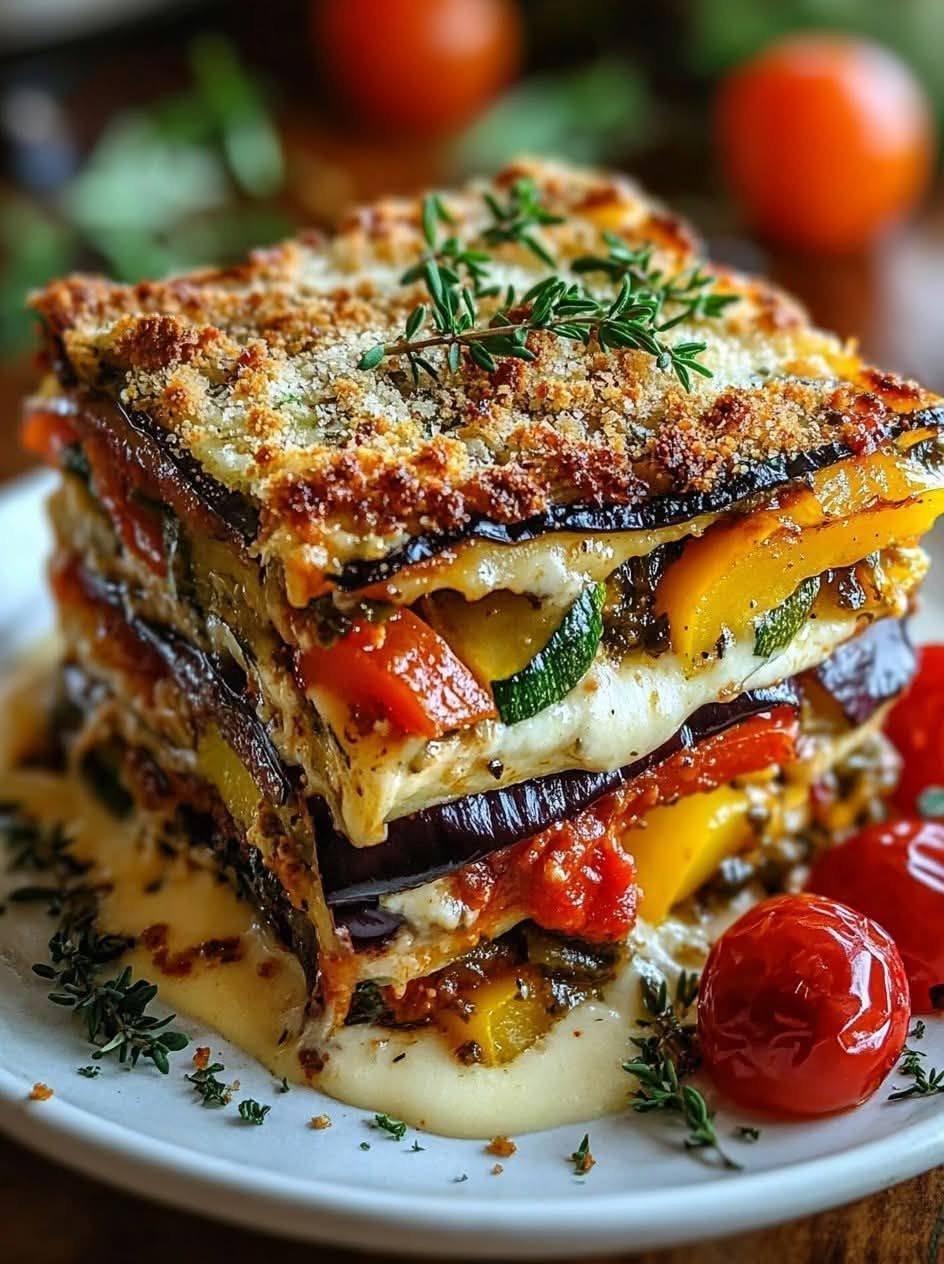
Roasted Vegetable & Eggplant Lasagna
Description
Roasted Vegetable & Eggplant Lasagna is a hearty, comforting vegetarian twist on classic lasagna. Instead of relying only on meat or a heavy filling, this version layers tender roasted eggplant, zucchini, bell peppers, spinach, rich tomato sauce, creamy ricotta, mozzarella, and Parmesan between lasagna noodles.
Roasting the vegetables first is the secret to deep flavor. The high heat caramelizes their natural sugars and removes excess moisture, helping prevent a watery lasagna. The result is a beautifully layered dish with creamy cheese, savory tomato sauce, tender vegetables, and golden melted cheese on top.
It is perfect for family dinners, Sunday meals, vegetarian gatherings, meal prep, and holiday tables.
Prep Time: 30 minutes
Roasting Time: 25 minutes
Baking Time: 40 minutes
Total Time: About 1 hour 35 minutes
Servings: 8
Course: Main Dish
Cuisine: Italian-Inspired
Difficulty: Moderate
Ingredients
For the Roasted Vegetables
- 1 large eggplant, diced
- 2 medium zucchini, diced
- 1 red bell pepper, diced
- 1 yellow bell pepper, diced
- 1 small red onion, sliced
- 2 tablespoons olive oil
- 3 cloves garlic, minced
- 1 teaspoon dried oregano
- 1 teaspoon Italian seasoning
- ½ teaspoon smoked paprika
- ½ teaspoon salt
- ½ teaspoon black pepper
For the Cheese Filling
- 15 oz ricotta cheese
- 1 large egg
- ½ cup grated Parmesan cheese
- 2 cups fresh spinach, finely chopped
- 1 teaspoon Italian seasoning
- ¼ teaspoon black pepper
- ¼ teaspoon salt
For Assembly
- 9–12 lasagna noodles
- 4 cups marinara sauce
- 2½ cups shredded mozzarella cheese
- ½ cup grated Parmesan cheese
- 2 tablespoons chopped fresh basil
- Fresh parsley, for garnish
Instructions
1. Prepare the Oven
Preheat the oven to 425°F (220°C).
Line a large baking sheet with parchment paper.
Roasting the vegetables at a high temperature helps them develop browned edges and concentrated flavor.
2. Prepare the Vegetables
Dice the eggplant, zucchini, and bell peppers into relatively similar-sized pieces.
Place them in a large bowl along with the sliced red onion.
Add olive oil, garlic, oregano, Italian seasoning, smoked paprika, salt, and black pepper.
Toss thoroughly until the vegetables are evenly coated.
Spread them in a single layer on the prepared baking sheet.
Avoid overcrowding because crowded vegetables tend to steam instead of roast.
3. Roast the Vegetables
Roast for approximately 20–25 minutes, stirring once halfway through.
The vegetables should become tender with browned, caramelized edges.
Remove from the oven and allow them to cool slightly.
If the eggplant seems particularly moist, let the roasted vegetables sit for several minutes so excess steam can escape.
4. Prepare the Lasagna Noodles
Cook the lasagna noodles according to the package directions until just tender.
Do not overcook them because they will continue cooking in the oven.
Drain and lay the noodles flat so they don’t stick together.
You can also use oven-ready noodles if preferred.
5. Prepare the Ricotta Filling
In a large bowl, combine:
- Ricotta cheese
- Egg
- Parmesan
- Chopped spinach
- Italian seasoning
- Salt
- Black pepper
Stir until smooth and evenly combined.
The spinach can be used raw because it will cook during baking.
6. Prepare for Assembly
Reduce the oven temperature to 375°F (190°C).
Lightly grease a 9 × 13-inch baking dish.
Spread approximately ½ cup of marinara sauce across the bottom.
This prevents the noodles from sticking and creates a flavorful base.
7. Build the First Layer
Place a layer of lasagna noodles over the sauce.
Spread approximately one-third of the ricotta mixture over the noodles.
Add one-third of the roasted vegetables.
Spoon marinara sauce over the vegetables.
Sprinkle with mozzarella.
8. Continue Layering
Repeat the layers:
Noodles → ricotta mixture → roasted vegetables → marinara sauce → mozzarella
Continue until the ingredients are used.
Finish with a final layer of noodles, marinara sauce, mozzarella, and Parmesan.
Make sure the noodles are completely covered with sauce so they don’t dry out during baking.
9. Bake the Lasagna
Cover the baking dish tightly with aluminum foil.
Bake at 375°F (190°C) for approximately 25 minutes.
Remove the foil and continue baking for another 15–20 minutes, until the cheese is melted, bubbling, and golden.
For an extra-browned top, broil for 1–2 minutes at the end.
Watch carefully during broiling.
10. Rest Before Serving
Remove the lasagna from the oven and allow it to rest for 15–20 minutes before slicing.
This is an important step because it allows the layers to set.
If you cut the lasagna immediately, the filling may spread and the slices won’t hold their shape as well.
Garnish with fresh basil or parsley before serving.
Notes
Eggplant
Choose a firm eggplant with smooth, shiny skin.
Roasting it before assembling the lasagna concentrates its flavor and removes excess moisture.
Vegetables
Feel free to substitute vegetables according to the season.
Mushrooms, yellow squash, carrots, spinach, or roasted tomatoes can all work well.
Sauce
Use a thick marinara sauce rather than a watery tomato sauce.
A thick sauce helps maintain the structure of the lasagna.
Cheese
For the best texture, use whole-milk ricotta and freshly shredded mozzarella.
Pre-shredded mozzarella can work, but freshly shredded cheese usually melts more smoothly.
Tips for the Best Lasagna
1. Don’t Skip Roasting
Raw vegetables release water during baking, which can make lasagna watery.
Roasting first creates deeper flavor and better texture.
2. Don’t Overcrowd the Baking Sheet
Spread the vegetables out so they roast instead of steam.
Use two baking sheets if necessary.
3. Season Every Layer
Proper seasoning makes a major difference because the vegetables and cheese need enough flavor to balance the noodles and sauce.
4. Don’t Add Too Much Sauce
A generous amount is good, but excessive sauce can make the lasagna difficult to slice.
5. Rest Before Cutting
Give the lasagna at least 15 minutes to settle after baking.
6. Cover While Baking
The foil traps steam and helps cook the noodles evenly.
Removing the foil at the end allows the cheese to brown.
Serving Suggestions
Serve this lasagna with a crisp green salad dressed with lemon and olive oil.
A simple tomato-cucumber salad also provides freshness against the rich cheese layers.
For a more substantial Italian-inspired meal, serve alongside:
- Garlic bread
- Crusty sourdough
- Roasted asparagus
- Steamed broccoli
- Arugula salad
- Tomato salad
- Grilled vegetables
A small drizzle of extra-virgin olive oil and fresh basil makes a beautiful finishing touch.
Make-Ahead Instructions
This lasagna is excellent for meal preparation.
You can assemble it completely, cover it tightly, and refrigerate it for up to 24 hours before baking.
If baking directly from the refrigerator, allow additional cooking time because the center will be cold.
You can also prepare the roasted vegetables and ricotta filling separately a day ahead.
Storage
Store leftover lasagna in an airtight container or tightly covered baking dish in the refrigerator for 3–4 days.
Reheat individual portions in the microwave or reheat larger portions in a covered oven-safe dish.
For a crispier top, uncover the lasagna during the final few minutes of reheating.
Freezing Instructions
This lasagna freezes well.
Allow the baked lasagna to cool completely.
Cut it into individual portions and wrap them tightly before placing them in a freezer-safe container.
Freeze for up to approximately 2–3 months for best quality.
Thaw overnight in the refrigerator and reheat until hot throughout.
You can also freeze an assembled, unbaked lasagna. Wrap it very tightly and freeze before baking.
Servings
This recipe makes approximately 8 servings.
For a larger gathering, double the recipe and use two baking dishes.
For a smaller family, the assembled lasagna can be divided into two smaller dishes, with one frozen for later.
Approximate Nutritional Information
Estimated per serving:
- Calories: 420–480 kcal
- Protein: 22–26 g
- Carbohydrates: 45–52 g
- Dietary Fiber: 7–9 g
- Total Fat: 18–22 g
- Saturated Fat: 8–10 g
- Cholesterol: 65–80 mg
- Sodium: 750–950 mg
- Potassium: 700–850 mg
Nutrition varies depending on the noodles, marinara sauce, cheese, and exact amount of vegetables used.
Benefits
1. Vegetable-Rich
Eggplant, zucchini, peppers, onion, and spinach provide a variety of vegetables in one satisfying meal.
2. Good Source of Protein
Ricotta, mozzarella, Parmesan, and egg provide protein.
3. Provides Fiber
Eggplant, zucchini, peppers, spinach, and tomato sauce contribute dietary fiber.
4. Contains Calcium
The dairy ingredients provide calcium, which supports normal bone and muscle function.
5. Provides Antioxidant Compounds
Colorful vegetables and tomatoes contain various plant compounds, including carotenoids and other antioxidants.
6. Satisfying Meatless Meal
The combination of vegetables, noodles, and several types of cheese makes this a hearty vegetarian main course.
Frequently Asked Questions
Q1: Can I use different vegetables?
Absolutely. Mushrooms, spinach, carrots, squash, roasted tomatoes, and bell peppers are excellent choices.
Q2: Do I need to salt the eggplant first?
Modern eggplants are generally less bitter than older varieties, so pre-salting isn’t always necessary. However, salting can help draw out some moisture.
Q3: Can I skip roasting the vegetables?
You can, but roasting is strongly recommended for better flavor and a less watery lasagna.
Q4: Can I use frozen spinach?
Yes. Thaw it completely and squeeze out as much liquid as possible before adding it to the ricotta mixture.
Q5: Can I use cottage cheese instead of ricotta?
Yes. Cottage cheese can be blended until smooth for a ricotta-like texture.
Q6: Can I make this gluten-free?
Yes. Use gluten-free lasagna noodles and verify that your marinara sauce and other packaged ingredients are gluten-free.
Q7: Can I make it vegetarian?
Yes. The recipe is vegetarian as written, provided the cheeses and sauces you choose are vegetarian-friendly.
Q8: Can I make it vegan?
Yes, with plant-based ricotta, mozzarella, Parmesan alternatives, and an egg substitute.
Q9: Why is my lasagna watery?
The most common reasons are watery vegetables, thin sauce, or insufficient roasting. Roast the vegetables thoroughly and use a thick marinara.
Q10: How long should lasagna rest?
Allow it to rest for 15–20 minutes before slicing.
Q11: Can I make it ahead?
Yes. Assemble it up to 24 hours ahead and refrigerate until ready to bake.
Q12: Can I freeze leftovers?
Yes. Individual portions freeze particularly well.
Q13: Can I use no-boil noodles?
Yes. Follow the package instructions and make sure there is enough sauce to hydrate them.
Q14: Can I add meat?
Yes. Cooked ground turkey, chicken, or beef can be added if you don’t need the dish to remain vegetarian.
Q15: What cheese works best?
Ricotta, mozzarella, and Parmesan create a classic creamy and cheesy combination. Goat cheese or feta can also add a delicious twist.
Q16: Can I add fresh herbs?
Yes. Basil, parsley, oregano, and thyme are excellent additions.
Q17: Can I use store-bought marinara?
Absolutely. A good-quality thick marinara makes this recipe much faster.
Q18: How do I get a golden top?
Remove the foil during the final 15–20 minutes and briefly broil at the end if desired.
Q19: What should I serve with this lasagna?
A crisp green salad, garlic bread, roasted vegetables, or a simple tomato salad are excellent choices.
Q20: Why is roasting the vegetables important?
Roasting caramelizes the vegetables, intensifies their flavor, softens them, and removes excess moisture. This helps create a richer, more flavorful lasagna with better texture.