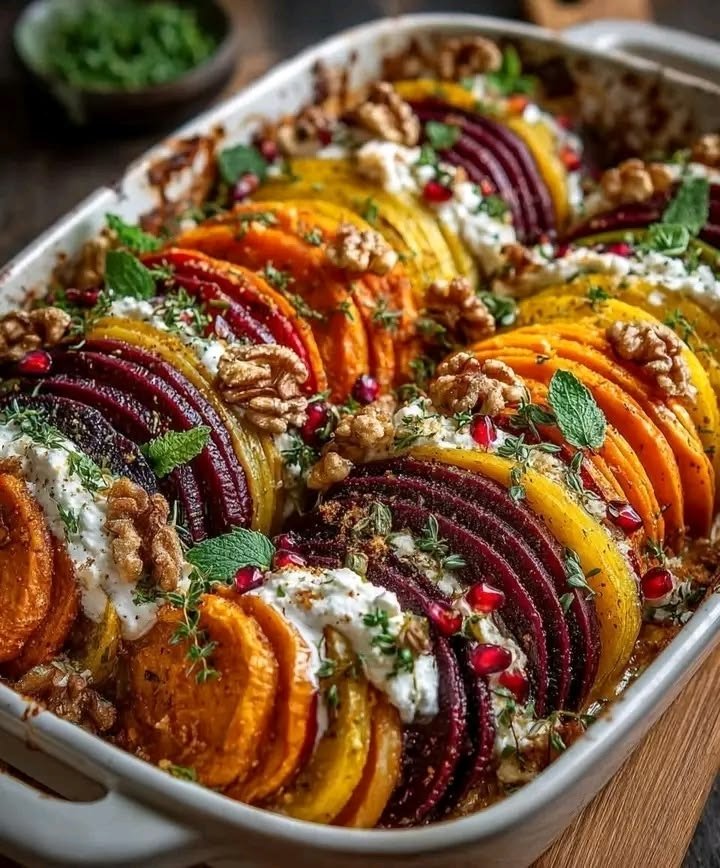
Roasted Beet, Sweet Potato, and Squash Tian
Description
Roasted Beet, Sweet Potato, and Squash Tian is a beautiful, colorful vegetable bake made with thinly sliced beets, sweet potatoes, and winter squash arranged in overlapping layers and roasted until tender and caramelized. Finished with garlic, fresh herbs, olive oil, and a touch of cheese, this dish is both elegant enough for a holiday table and simple enough for a comforting weeknight dinner.
A traditional tian is a rustic French-inspired vegetable dish in which sliced vegetables are arranged closely together and baked until their natural flavors intensify. This version combines the earthy sweetness of beets, the creamy texture of sweet potatoes, and the delicate sweetness of squash.
The vegetables become tender inside while their exposed edges caramelize beautifully. Fresh thyme, garlic, black pepper, and Parmesan or feta add savory depth that balances the natural sweetness of the vegetables.
It makes an excellent vegetarian side dish for Thanksgiving, Christmas, Sunday dinner, or any autumn and winter gathering. It can also be served as a light main course with a green salad, crusty bread, beans, or lentils.
Prep Time: 25 minutes
Cook Time: 55–65 minutes
Total Time: About 1 hour 25 minutes
Servings: 6–8
Course: Side Dish / Vegetarian Main
Cuisine: French-Inspired
Difficulty: Easy to Moderate
Ingredients
Vegetables
3 medium beets, peeled
2 medium sweet potatoes, peeled
1 small butternut squash, peeled and seeded
1 small yellow onion, thinly sliced
3 cloves garlic, minced
3 tablespoons extra-virgin olive oil
1 teaspoon fresh thyme leaves
½ teaspoon dried oregano
½ teaspoon black pepper
½ teaspoon salt
¼ teaspoon red pepper flakes, optional
For the Topping
½ cup freshly grated Parmesan cheese
¼ cup crumbled feta, optional
1 tablespoon fresh parsley, chopped
1 teaspoon fresh thyme leaves
1 tablespoon olive oil
Optional Garnishes
Fresh rosemary
Toasted walnuts or pecans
Pumpkin seeds
Lemon zest
Balsamic glaze
Fresh parsley
Flaky sea salt
Instructions
1. Preheat the Oven
Preheat your oven to 400°F (200°C).
Lightly grease a large round or oval baking dish with olive oil.
A shallow baking dish works particularly well because it allows the vegetables to roast evenly.
2. Prepare the Vegetables
Peel the beets and sweet potatoes.
Carefully peel the butternut squash, remove the seeds, and cut it into manageable pieces.
Using a sharp knife or mandoline, slice all three vegetables into approximately ⅛-inch to ¼-inch thick slices.
Try to keep the slices relatively similar in thickness.
This helps them cook evenly.
Beets can stain cutting boards and hands, so use gloves or wash your hands and equipment promptly after preparing them.
3. Prepare the Garlic-Herb Oil
In a small bowl, combine:
Olive oil
Minced garlic
Fresh thyme
Oregano
Black pepper
Salt
Red pepper flakes, if using
Whisk everything together.
This mixture will coat the vegetables and add flavor throughout the bake.
4. Add the Onion
Spread the thinly sliced onion evenly across the bottom of the baking dish.
The onion creates a flavorful base and becomes soft and caramelized as the vegetables roast.
5. Arrange the Vegetables
Begin arranging the vegetable slices vertically in the baking dish.
Alternate between beet, sweet potato, and squash.
For example:
Beet → Sweet Potato → Squash → Beet → Sweet Potato → Squash
Continue until the entire dish is filled.
Arrange the slices tightly so they support each other.
The vegetables will shrink slightly during roasting, so a packed arrangement is ideal.
6. Add the Garlic-Herb Oil
Drizzle the garlic-herb oil evenly over the arranged vegetables.
Use a pastry brush to spread the oil across the exposed surfaces if needed.
Try to distribute the garlic and herbs throughout the dish rather than allowing them to remain in one area.
7. Cover and Bake
Cover the baking dish tightly with aluminum foil.
Bake for approximately 30–35 minutes.
The steam created under the foil helps the vegetables begin cooking and softening.
8. Remove the Foil
After the initial baking period, carefully remove the foil.
The vegetables should have started to soften.
If they still feel very firm, cover them again and bake for another 5–10 minutes.
9. Add Cheese
Sprinkle the Parmesan evenly over the top.
If using feta, scatter it over the vegetables as well.
Drizzle with the remaining tablespoon of olive oil.
Return the uncovered dish to the oven.
10. Roast Until Golden
Continue baking for another 20–30 minutes.
The vegetables should be completely tender when pierced with a knife.
The edges should be caramelized and golden.
If you want additional browning, switch the oven to broil for 1–2 minutes at the end.
Watch carefully because cheese and thin vegetable edges can brown quickly.
11. Rest
Remove the tian from the oven and let it rest for approximately 10 minutes.
This allows the juices to settle and makes serving easier.
12. Garnish and Serve
Finish with fresh parsley and thyme.
For an extra special presentation, add toasted walnuts or pecans and a small drizzle of balsamic glaze.
Serve warm or at room temperature.
Notes
Slice the Vegetables Evenly
Uniform slices are important.
If some pieces are very thick and others very thin, the thin slices may become overly soft before the thick ones are fully cooked.
Use a Mandoline Carefully
A mandoline makes beautiful, consistent slices, but always use the safety guard and handle it carefully.
Don’t Use Too Much Oil
The vegetables need enough oil to roast and caramelize, but excessive oil can make the dish greasy.
Pack the Dish Tightly
A tightly arranged tian looks beautiful and helps the vegetables steam and roast together.
Cover First, Then Roast Uncovered
Covering helps soften the vegetables.
Removing the foil allows moisture to evaporate and encourages caramelization.
Tips for Perfect Roasted Vegetable Tian
1. Choose Vegetables With Similar Thickness
This is more important than having identical vegetable sizes.
Similar slice thickness means everything finishes at approximately the same time.
2. Don’t Rush the Roasting
Root vegetables need enough time to become tender.
The final uncovered roasting stage is important for developing deep flavor.
3. Season Between Layers if Desired
For an especially flavorful version, lightly sprinkle herbs and seasoning over every few layers.
Avoid excessive salt if you’re using Parmesan or feta.
4. Add Cheese Near the End
Adding cheese too early can cause it to brown before the vegetables are finished.
5. Let It Rest
A short resting period allows the vegetables to settle and makes the dish easier to serve.
Flavor Variations
Mediterranean Tian
Add feta, oregano, parsley, garlic, and a drizzle of lemon-infused olive oil.
Balsamic Roasted Vegetable Tian
Finish with a light drizzle of balsamic glaze after baking.
Maple Herb Tian
Add 1–2 teaspoons of maple syrup to the olive oil mixture for a sweeter autumn-inspired version.
Garlic Parmesan Tian
Use extra Parmesan, garlic, thyme, and black pepper.
Spicy Tian
Add red pepper flakes or a small pinch of cayenne.
Nutty Holiday Tian
Top with toasted pecans or walnuts after baking.
Cranberry Version
Scatter a small amount of dried cranberries over the finished dish for a sweet-tart contrast.
Vegan Tian
Omit the cheese or use a plant-based Parmesan alternative.
Serving Suggestions
This vegetable bake works beautifully as a side dish for:
Roast chicken
Turkey
Baked salmon
Grilled fish
Roast beef
Lentil dishes
Chickpea dishes
White beans
Green salads
For a vegetarian meal, serve it with a hearty grain such as quinoa, farro, couscous, or brown rice.
A dollop of Greek yogurt or garlic yogurt on the side can also provide a refreshing contrast.
For a Mediterranean-inspired plate, combine the tian with chickpeas, cucumber salad, hummus, olives, and warm crusty bread.
Make-Ahead Instructions
This dish is excellent for entertaining because much of the preparation can be completed ahead.
You can peel and slice the vegetables several hours before cooking.
Store sliced vegetables separately in airtight containers in the refrigerator.
The garlic-herb oil can also be prepared a day ahead.
For best results, arrange and bake the tian shortly before serving.
You can also fully bake it earlier in the day and reheat it before dinner.
Storage
Allow leftovers to cool before transferring them to an airtight container.
Refrigerate for approximately 3–4 days.
The flavors often become even more developed after resting overnight.
Reheating Instructions
For the best texture, reheat the tian in the oven.
Place it in a baking dish and cover loosely with foil.
Heat at 350°F (175°C) for approximately 15–20 minutes.
Remove the foil during the final few minutes to restore some crispness to the edges.
An air fryer can also be used for individual portions.
Freezing
Freezing is possible, but the texture of the vegetables may become softer after thawing.
If you decide to freeze it, allow the cooked tian to cool completely.
Place portions in freezer-safe containers.
Freeze for up to approximately 2 months.
Thaw overnight in the refrigerator and reheat in the oven.
For the best texture, fresh preparation is recommended.
Servings
This recipe makes approximately 6 generous side-dish servings or 8 smaller servings.
For a holiday meal with several side dishes, 8 servings is realistic.
If served as the main vegetarian dish, plan for approximately 4–5 servings and pair it with salad, grains, beans, or bread.
Approximate Nutritional Information
Estimated per serving, based on 6 servings and including Parmesan:
Calories: 260–310 kcal
Protein: 7–9 g
Carbohydrates: 35–40 g
Dietary Fiber: 7–9 g
Total Fat: 11–14 g
Saturated Fat: 3–4 g
Cholesterol: 8–12 mg
Sodium: 400–500 mg
Potassium: 750–900 mg
Calcium: 120–170 mg
Nutrition will vary depending on vegetable sizes, cheese, oil, and toppings.
Benefits
1. Rich in Vegetables
This recipe combines several colorful vegetables in one dish, making it an easy way to increase vegetable variety.
2. Good Source of Fiber
Beets, sweet potatoes, and squash provide dietary fiber that supports normal digestive health.
3. Provides Vitamin A
Sweet potatoes and winter squash are rich in beta-carotene, which the body can convert to vitamin A.
4. Provides Vitamin C
Beets and squash contribute vitamin C along with other nutrients.
5. Contains Potassium
Sweet potatoes and squash provide potassium, an important mineral involved in normal muscle and nerve function.
6. Antioxidant-Rich Ingredients
The colorful vegetables contain various plant compounds that contribute to a balanced, nutrient-rich diet.
7. Healthy Fats
Extra-virgin olive oil contributes primarily unsaturated fats.
8. Vegetarian-Friendly
The recipe can be served as a vegetarian side dish or adapted into a complete meat-free meal.
Note: These nutritional benefits are based on the ingredients themselves and do not make the dish a treatment or cure for any health condition.
Frequently Asked Questions
Q1: What is a tian?
A tian is a French-inspired vegetable dish in which sliced vegetables are arranged in a baking dish and roasted until tender and caramelized.
Q2: Can I use different vegetables?
Absolutely. Zucchini, tomatoes, carrots, potatoes, eggplant, onions, and other roasting vegetables can be incorporated.
Q3: Do I have to use beets?
No. You can replace them with carrots, red potatoes, or another firm vegetable.
Q4: Can I use delicata squash?
Yes. Delicata squash is excellent because its skin is edible when properly washed.
Q5: Do I need to peel the butternut squash?
Yes, unless you’re using a variety with edible skin.
Q6: Can I use frozen vegetables?
Fresh vegetables are strongly recommended because frozen vegetables release more moisture and may not caramelize as well.
Q7: Why do I cover the tian first?
Covering the dish traps steam and helps the dense root vegetables become tender.
Q8: Why remove the foil later?
The uncovered cooking stage allows excess moisture to evaporate and encourages browning and caramelization.
Q9: Can I make this without cheese?
Yes. Simply omit the Parmesan and feta or use a dairy-free alternative.
Q10: Can I use feta instead of Parmesan?
Yes. Feta gives the dish a tangy, salty Mediterranean flavor.
Q11: Can I make it vegan?
Yes. Omit the dairy cheese or use a plant-based cheese alternative.
Q12: How can I make the vegetables more caramelized?
Don’t overcrowd the dish with excessive liquid, remove the foil during the final roasting stage, and allow enough cooking time.
Q13: Can I add garlic?
Yes. Fresh garlic works beautifully with the sweet vegetables.
Q14: Can I add herbs?
Definitely. Thyme, rosemary, parsley, sage, and oregano are excellent options.
Q15: Can I add nuts?
Yes. Toasted walnuts, pecans, or pumpkin seeds provide excellent texture.
Q16: Can I make it spicy?
Yes. Add red pepper flakes, chili powder, or a small amount of cayenne.
Q17: Why are my beets still hard?
Beets can vary considerably in density. If your slices are thicker, they may need additional cooking time. Cover the dish and continue baking until tender.
Q18: Can I prepare this the night before?
You can prepare the components ahead, but for the freshest appearance, assemble and bake it on the day of serving.
Q19: Can I serve it at room temperature?
Yes. The tian is delicious warm or at room temperature.
Q20: What sauce goes well with it?
Garlic yogurt, tahini sauce, lemon yogurt, or a light balsamic glaze all work well.
Q21: Is this suitable for a holiday dinner?
Absolutely. The red, orange, and golden colors make it especially attractive for Thanksgiving and Christmas tables.
Q22: Can I use sweet potato and butternut squash together?
Yes. Their naturally sweet flavors complement each other extremely well.
Q23: How do I prevent the dish from becoming watery?
Don’t add excessive liquid, use fresh vegetables, and roast uncovered long enough for excess moisture to evaporate.
Q24: Can I use a rectangular baking dish?
Yes. The shape doesn’t matter as long as the vegetables fit comfortably and can be arranged tightly.
Q25: What is the best way to cut the vegetables?
Thin, uniform slices approximately ⅛–¼ inch thick are ideal