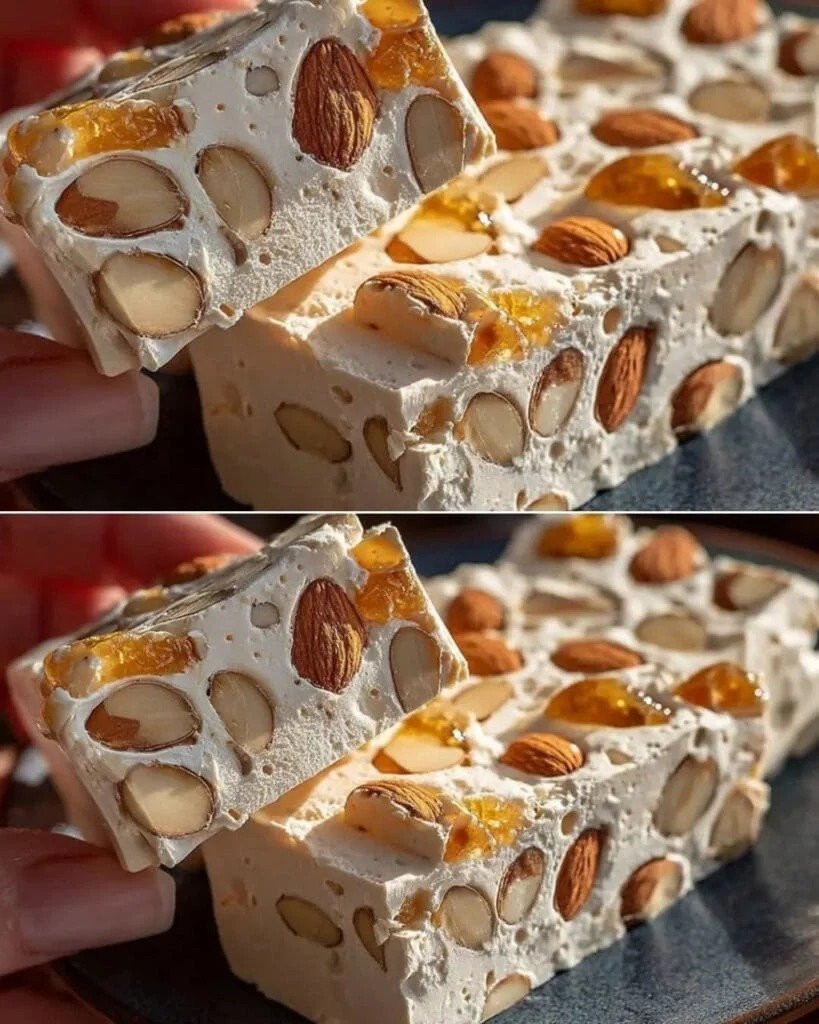
Mediterranean Traditional Almond Nougat
Mediterranean Traditional Almond Nougat is a classic honey-sweetened confection made with toasted almonds, whipped egg whites, and a carefully cooked sugar syrup. It has a wonderfully chewy texture, delicate floral aroma, and rich roasted-nut flavor that makes it perfect for holidays, gifting, or a special homemade treat.
Prep Time: 20 minutes
Cook Time: 45–60 minutes
Setting Time: 4–6 hours
Total Time: About 5–7 hours
Servings: 24 pieces
Ingredients
For the Nougat Base
Honey: 1 cup (340 g) high-quality orange blossom or wildflower honey
Granulated Sugar: 1½ cups (300 g)
Liquid Glucose or Light Corn Syrup: ½ cup (160 g)
Water: ¼ cup (60 ml)
Egg Whites: 2 large egg whites, about 60 g total
Vanilla Extract: 1 teaspoon
Salt: ⅛ teaspoon
For the Almonds
Blanched Whole Almonds: 2 cups (280–300 g)
Orange Blossom Water: 1 teaspoon, optional
Finely Grated Orange Zest: 1 teaspoon, optional
For Lining & Handling
Edible Rice Paper/Wafer Paper: 2 large sheets, enough to cover the bottom and top of an approximately 8-inch square pan
Neutral Oil: A small amount for lightly greasing the pan and utensils, if needed
Instructions
Prepare the Pan and Almonds
Line an approximately 8-inch square baking pan with edible rice paper or wafer paper. Place one sheet on the bottom and reserve the second sheet for the top. If your rice paper is smaller than the pan, overlap pieces slightly so the entire surface is covered.
Lightly grease the sides of the pan with a small amount of neutral oil. Set the prepared pan aside.
Preheat the oven to 300°F (150°C). Spread the blanched almonds in a single layer on a baking sheet. Toast them for approximately 10–15 minutes, stirring once or twice, until they become lightly golden and fragrant.
Keep the toasted almonds warm. This is important because adding cold almonds to hot nougat can cause the mixture to cool too quickly and become difficult to spread.
Prepare the Honey Syrup
Pour the honey into a heavy-bottomed saucepan. Place it over medium-low heat and bring it to a gentle simmer.
Allow the honey to cook slowly while you prepare the sugar syrup. Avoid letting it scorch. If necessary, reduce the heat to maintain a steady, gentle bubbling.
In a separate heavy saucepan, combine the granulated sugar, liquid glucose or light corn syrup, and water.
Stir gently over medium heat until the sugar dissolves. Once the syrup begins boiling, stop stirring. Continue cooking until it reaches approximately 290°F (143°C) on a reliable candy thermometer.
The exact temperature is important because it determines the final texture of the nougat. A lower temperature generally produces softer nougat, while a higher temperature creates a firmer, more brittle confection.
Whip the Egg Whites
While the sugar syrup is cooking, place the egg whites in the clean bowl of a stand mixer.
Whip them on medium speed until they become foamy, then increase the speed and continue beating until they form soft to medium peaks.
The egg whites should be ready when the syrups reach the correct temperature. Do not whip them excessively far in advance, as they may lose volume while waiting.
Combine the Syrups
Once the honey is hot and the sugar syrup has reached approximately 290°F (143°C), slowly pour the hot honey into the whipped egg whites while the mixer is running on low speed.
Increase the mixer speed gradually and continue beating.
Next, very slowly drizzle the hot sugar and glucose syrup into the egg-white mixture. Pour it down the side of the bowl rather than directly onto the whisk to reduce splashing.
Continue mixing until the mixture becomes thick, glossy, pale, and noticeably increases in volume.
This process may take 10–20 minutes, depending on your mixer and the final texture you’re aiming for.
Add Flavoring
Add the vanilla extract and salt. If using orange blossom water or orange zest, add them at this stage as well.
Mix briefly until the flavorings are evenly incorporated.
The mixture should now be extremely thick and sticky. It should hold its shape when lifted with a spatula.
Fold in the Almonds
Add the warm toasted almonds to the nougat mixture.
Using a sturdy heat-resistant spatula or wooden spoon, fold the almonds through the nougat until they are evenly distributed.
Work relatively quickly because the mixture will become increasingly difficult to spread as it cools.
Transfer and Shape the Nougat
Immediately scrape the warm nougat into the prepared pan.
Place the second sheet of edible rice paper over the top. Using lightly oiled parchment paper, another flat pan, or a rolling pin, gently press and smooth the nougat into an even layer.
Do not press so hard that you crush the almonds. The goal is simply to create a compact, level slab.
Allow the nougat to cool at room temperature until firm enough to cut. Depending on the humidity and thickness, this can take approximately 4–6 hours.
For a cleaner cut, you can allow it to set longer or chill it briefly once it has cooled.
Cut and Serve
Once completely set, lift the nougat slab from the pan.
Use a sharp knife lightly coated with neutral oil to cut it into approximately 24 pieces. If the nougat is particularly firm, allow it to sit at room temperature for a few minutes before cutting.
Serve the almond nougat at room temperature.
Store individual pieces between sheets of parchment or edible rice paper to prevent them from sticking together.
Tips
Use a Reliable Candy Thermometer
Temperature is one of the most important factors when making nougat. Use a reliable candy thermometer and make sure its tip is properly positioned in the syrup without touching the bottom of the saucepan.
Keep the Almonds Warm
Warm almonds blend into the nougat much more easily than cold almonds. Keep them in a low oven until you’re ready to fold them into the mixture.
Don’t Stir the Boiling Sugar Syrup
Once the sugar mixture reaches a boil, avoid stirring it. Stirring can encourage unwanted crystallization and may affect the smooth texture of the finished nougat.
Work Quickly After Adding the Almonds
Nougat becomes increasingly thick as it cools. Have your lined pan and tools ready before adding the almonds so you can transfer and shape the mixture without delay.
Be Extremely Careful With Hot Syrup
Boiling sugar and honey reach temperatures capable of causing severe burns. Use long sleeves, heat-resistant gloves when appropriate, and keep children away from the cooking area. Never touch the hot nougat or syrup with bare hands.
Use Fresh, High-Quality Almonds
Fresh almonds provide a much better flavor and texture. Lightly toasting them enhances their natural nuttiness and gives the finished nougat a delicious roasted aroma.
Variations
Orange Blossom Almond Nougat
For a distinctly Mediterranean floral character, add 1 teaspoon orange blossom water along with the vanilla. You can also add 1 teaspoon finely grated orange zest for additional citrus brightness.
Pistachio & Almond Nougat
Replace up to ½ cup of the almonds with shelled pistachios. The pistachios add a beautiful green color and a slightly buttery flavor while keeping the traditional nutty character.
Hazelnut Nougat
Replace some or all of the almonds with toasted hazelnuts. Remove loose skins after roasting for a smoother flavor.
Citrus Nougat
Add finely grated lemon or orange zest to the finished nougat mixture. Start with about 1 teaspoon and increase slightly according to taste.
Rose-Flavored Nougat
For another traditional Mediterranean-inspired variation, replace the orange blossom water with ½–1 teaspoon rose water. Use it sparingly because rose water has a strong floral flavor.
Q&A
What makes Mediterranean almond nougat different from ordinary candy?
Traditional nougat gets its distinctive texture from whipped egg whites combined with carefully cooked honey and sugar syrups. Toasted almonds provide the characteristic crunch and nutty flavor.
Why is liquid glucose or corn syrup used?
It helps control sugar crystallization, resulting in a smoother and more consistent nougat texture.
Can I use raw almonds?
Yes, but blanched almonds are traditionally preferred for a cleaner appearance and smoother bite. Whichever type you use, toast them lightly before adding them to the nougat.
Why does my nougat become too hard?
The final syrup temperature has a major effect on texture. Cooking the syrup to a higher temperature produces a firmer nougat. Humidity and cooking time can also affect the final result.
Why is my nougat sticky?
Nougat can remain sticky if the syrup does not reach a sufficiently high temperature or if it is made in a very humid environment. Allowing it to cool and set completely can also improve its texture.
Do I have to use rice paper?
Rice paper is traditional and makes the nougat much easier to handle. If you don’t have it, parchment can be used for lining the pan, although the finished nougat may be stickier to handle.
Can I make nougat without almonds?
Yes. You can substitute pistachios, hazelnuts, or a combination of nuts. However, almonds provide the classic Mediterranean nougat flavor and texture.
How should I store homemade nougat?
Store the nougat in an airtight container in a cool, dry place. Separate pieces with rice paper or parchment to prevent them from sticking together. Avoid humid areas because moisture can soften the candy.
Can I refrigerate nougat?
Refrigeration isn’t usually necessary and can introduce moisture when the candy is removed from the refrigerator. A cool, dry pantry is generally preferable.
Nutrition
Approximate nutrition per piece, based on 24 servings:
Calories: 170–190 kcal
Protein: 4–5 g
Carbohydrates: 28–31 g
Fat: 6–7 g
Saturated Fat: 0.5–1 g
Fiber: 1–2 g
Sugar: 25–28 g
Sodium: 15–30 mg
Nutrition information is an estimate and will vary according to the exact honey, sugar, almonds, serving size, and other ingredients used.
Conclusion
Mediterranean Traditional Almond Nougat is a beautiful homemade confection with a chewy honey-sweetened center and generous pieces of toasted almonds throughout. With patience and careful temperature control, you can create a classic treat that’s perfect for sharing, gifting, or enjoying with coffee.
#AlmondNougat #MediterraneanDessert #HomemadeNougat #TraditionalDesserts #HoneyNougat